

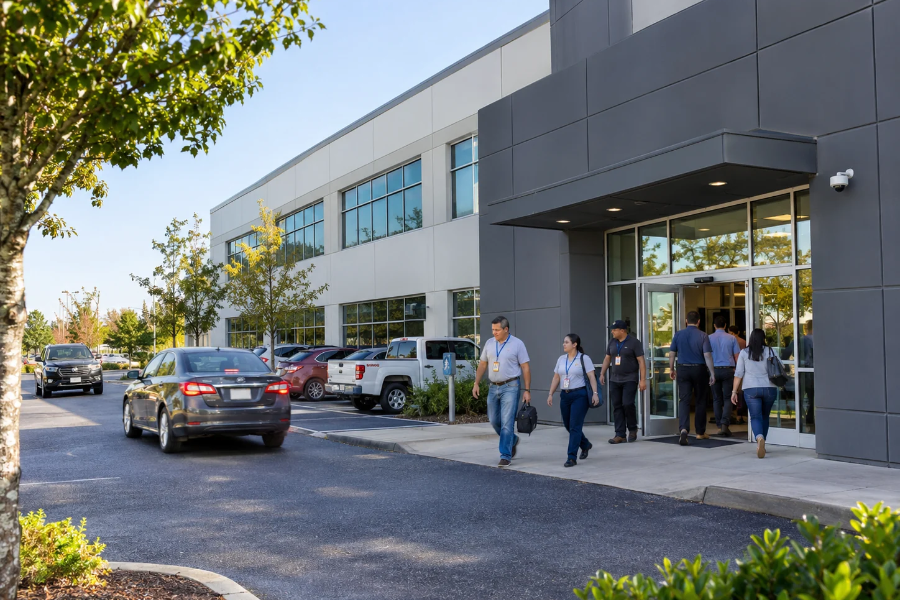
A commercial property might feel routine for most of a shift, then get significantly busier during the handoff between crews. As one group leaves and the next arrives, parking turns over, entrances see heavier use, and vehicle traffic can bunch up around gates within a short window.
For operations running multiple shifts, that transition merits its own security review. At Wolf Security Cameras, we work with businesses throughout the La Porte area to evaluate video surveillance around how their facilities operate under real conditions, including the periods when employee and vehicle traffic peak.
Review the Property Before the Next Shift Starts
Shift change often starts before one crew officially clocks out. The next shift may already be arriving, parking, and heading toward designated entrances while the current team is still on the job.
That overlap can put more people and vehicles in motion than the property sees most of the day. A camera that offers a clear view of an employee entrance during normal operations may have more to capture when several people approach at once. The same holds at vehicle gates, drive lanes, and parking areas where incoming and outgoing traffic converge.
That’s why a security review should occur while the transition is actually underway. Looking at the property during a quieter period may not reveal whether the existing camera positions provide enough detail when the site reaches one of its busiest routine points.
The Handoff Can Test Camera Placement
Shift change is a practical test of whether camera placement aligns with the questions management may eventually need answered.
At a vehicle gate, the critical view may be where traffic enters and exits rather than a distant view of the entire lot. Around an employee entrance, managers may need to understand how people approach and move through that access point when several employees are arriving or leaving at the same time.
Parking areas deserve similar attention. A camera that performs well once vehicles are stationary may deliver a different level of detail while spaces are turning over and traffic is moving in both directions.
The goal of reviewing these conditions is to determine whether existing surveillance still gives management useful information during the handoff. In some cases, the current system may already do that well. In others, a different camera angle or adjustment may make the busiest part of the day easier to understand later.
If shift change is one of the busiest periods on your property, we can help evaluate whether your current surveillance reflects how that handoff actually works. Call (866) 965-3226 or contact us to schedule a consultation.
After the Outgoing Shift Leaves, the Security Picture Changes Again
After the outgoing crew leaves and the next shift settles in, the property often becomes quieter. Staffing may be concentrated inside the facility, administrative personnel may no longer be present, and fewer people may be moving through exterior areas.
For businesses with overnight or early-morning operations, Remote Guarding can add live professional monitoring through designated cameras during periods when employees are not continuously watching surveillance feeds.
The monitoring plan should reflect the facility’s actual operating schedule. Early arrivals, late departures, scheduled vendors, and other authorized activity may be completely normal at a multi-shift business. Giving monitoring professionals clear expectations about those routines provides context for what they are seeing instead of treating activity outside traditional office hours as unusual by default.
That distinction matters on properties that never truly shut down. Security must account for the difference between a quiet facility and an inactive one.
Temporary Parking Changes Can Create a Separate Need
Staffing changes, construction, or facility expansion can push employee parking into an overflow lot or another area that was not part of the original surveillance plan. If that arrangement is temporary, permanently extending camera infrastructure may not be the most practical response.
A Mobile Security Trailer can establish a surveillance position closer to an overflow parking area, remote gate, or another location being used differently during shift changes. That gives the business a way to address a defined need without redesigning the entire security system around an arrangement that may change again.
If parking or traffic patterns shift again, the trailer can be repositioned to match the new priority.
This is a narrower use case than simply adding more cameras across the property. The trailer should address a specific visibility or monitoring need created by how employees are currently entering, leaving, or parking during the handoff.
Evaluate Security When the Property Is Under Real Pressure
Shift change is routine, yet it can place more demand on entrances, parking areas, vehicle routes, and surveillance views than quieter portions of the workday. That makes it one of the more useful times to evaluate how well the security system supports normal operations.
Businesses do not need to assume a busy handoff automatically calls for additional equipment. The better starting point is to observe the transition as it happens, determine where the current system provides useful information, and identify any specific areas that deserve closer attention.
For multi-shift operations, that review can provide a much clearer picture of how surveillance and monitoring perform when the property is busiest.
If you want to know how well your security system supports the transition between shifts, we can help review the property during the conditions that matter most. Call (866) 965-3226 or contact us to schedule a consultation.

License Info
B28569701Louisiana Fire Marshal License
F2810
Connect with Us